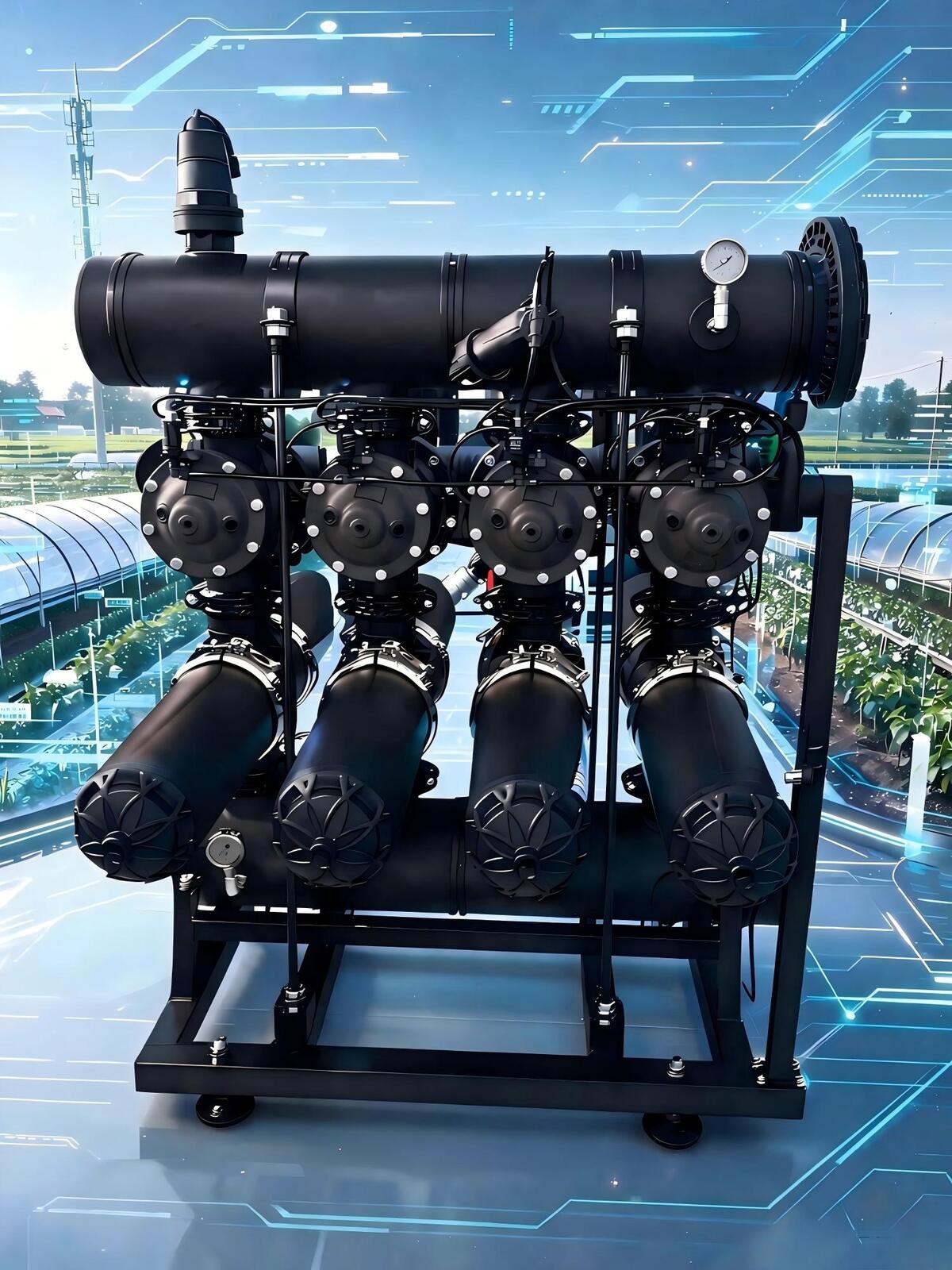
In modern agricultural irrigation systems, filtration equipment is a key component to protect drippers and sprinklers from clogging. A single filtration device often fails to meet the treatment requirements of complex water quality, so a multi-stage filtration system is required. This article will elaborate on the design methods and practical experience of agricultural irrigation multi-stage filtration systems.
1. Why a Multi-Stage Filtration System is Needed
1.1 Complexity of Source Water Quality
There are various water sources for agricultural irrigation, including well water, river water, reservoir water, pond water, reclaimed water, etc. The impurity content, particle size, and organic matter concentration of different water sources vary greatly. Even for the same water source, the water quality will change significantly in different seasons (such as rainy season and dry season).
A single filtration device can only treat impurities within a specific particle size range, and is often inadequate for complex water quality. For example, screen filters have high filtration precision but are easily clogged by large particle impurities; centrifugal filters have high sand removal efficiency but cannot remove fine organic impurities.
1.2 Protection Requirements for Irrigation Equipment
Modern irrigation systems extensively use precision emitters such as drippers and micro-sprinklers. These devices have very small flow channel sizes (usually only 0.5-1.5mm) and have high requirements for water quality. If impurities in the water are not effectively filtered, it will easily cause dripper clogging, affect irrigation uniformity, and even lead to the paralysis of the entire system.
Through the combination of different types of filtration equipment, the multi-stage filtration system can remove impurities of different particle sizes step by step, providing comprehensive protection for the irrigation system.
2. Composition of Multi-Stage Filtration System
A typical agricultural irrigation multi-stage filtration system usually consists of the following parts:
2.1 Primary Filtration (Coarse Filtration)
The main function of primary filtration is to remove large particle impurities in water, such as branches, leaves, plastic bags, large particle sediment, etc., to protect subsequent water pumps and filtration equipment.
Commonly used primary filtration equipment includes:
- Trash rack/filter screen: Installed at the water intake to intercept large floating debris and impurities
- Sand filter: Uses filter media such as quartz sand for filtration, suitable for water sources with high organic matter content
- Centrifugal filter: Uses centrifugal force to separate sediment, suitable for well water and river water with high sand content
For water sources with high sand content, it is recommended to use a centrifugal filter as the primary filtration; for water sources with high organic matter content, it is recommended to use a sand filter as the primary filtration.
2.2 Secondary Filtration (Fine Filtration)
The main function of secondary filtration is to further remove fine impurities in water, ensuring that the water quality entering the irrigation pipe network meets the requirements of drippers and sprinklers.
Commonly used secondary filtration equipment includes:
- Disc filter: Adopts three-dimensional deep filtration, with high filtration precision and strong dirt-holding capacity, and is the most commonly used secondary filtration equipment
- Screen filter: Adopts stainless steel filter screen, with high filtration precision but relatively weak dirt-holding capacity
- Disc + screen combination: For scenarios with particularly high water quality requirements, disc filters and screen filters can be connected in series
With its efficient three-dimensional deep filtration and excellent backwashing performance, the LZHS series disc filter is an ideal choice for secondary filtration.
2.3 Auxiliary Equipment
In addition to the main filtration equipment, the multi-stage filtration system also needs to be equipped with the following auxiliary equipment:
- Water pump: Provides the pressure and flow required by the system
- Pressure gauge: Monitors the pressure difference before and after the filter to determine whether backwashing is required
- Valve: Used for system control and maintenance
- Sewage pipe: Directs backwashing wastewater to the drainage ditch
- Control cabinet: Automatically controls the backwashing and sewage discharge of the filter
3. Design Principles of Multi-Stage Filtration System
3.1 Source Water Quality Analysis
Before designing a multi-stage filtration system, a detailed analysis of the source water quality must be conducted first, including:
- Suspended solids content (SS)
- Turbidity (NTU)
- Sand content
- Organic matter content
- Algae content
- pH value
- Hardness
The results of water quality analysis are an important basis for selecting the type and specification of filtration equipment.
3.2 Flow Design
The design flow of the system should be calculated and determined based on factors such as irrigation area, irrigation quota, and irrigation time. The rated flow of the filtration equipment should be greater than or equal to the maximum flow of the system, and it is generally recommended to leave a margin of 20-30%.
For automatic backwashing filters, the flow loss during backwashing also needs to be considered. During the backwashing process, some filter units are in the backwashing state, and the effective filtration area of the system will be reduced, so the number of filter units needs to be appropriately increased.
3.3 Selection of Filtration Precision
The selection of filtration precision depends on the irrigation method and emitter type:
- Drip irrigation system: It is recommended that the filtration precision is no less than 120 mesh (130 microns)
- Micro-sprinkler irrigation system: It is recommended that the filtration precision is no less than 150 mesh (100 microns)
- Sprinkler irrigation system: It is recommended that the filtration precision is no less than 80 mesh (200 microns)
- Gravity flow irrigation: It is recommended that the filtration precision is no less than 40 mesh (400 microns)
3.4 System Configuration
According to the source water quality and irrigation requirements, reasonably configure all levels of filtration equipment:
Solution 1: Centrifugal filter + Disc filter
- Suitable for: Well water and river water with high sand content
- Primary stage: Centrifugal filter removes large particle sediment
- Secondary stage: Disc filter removes fine impurities
Solution 2: Sand filter + Disc filter
- Suitable for: Reservoir water and pond water with high organic matter content
- Primary stage: Sand filter removes organic matter and algae
- Secondary stage: Disc filter performs fine filtration
Solution 3: Centrifugal filter + Sand filter + Disc filter
- Suitable for: Water sources with particularly poor water quality (such as river water in rainy season)
- Primary stage: Centrifugal filter removes sand
- Secondary stage: Sand filter removes organic matter
- Tertiary stage: Disc filter performs fine filtration
4. Installation and Commissioning
4.1 Installation Sequence
The installation sequence of the multi-stage filtration system is generally as follows:
Water source → Water intake filter screen → Water pump → Primary filtration → Secondary filtration → Fertilizer tank → Irrigation pipe network
Note: The fertilizer tank should be installed after the filter to prevent insoluble matter in the fertilizer from entering the filter and causing clogging.
4.2 Installation Key Points
- The filter should be installed on a flat foundation, and the inlet and outlet directions cannot be reversed
- Sufficient maintenance space should be reserved between filters at all levels
- Pressure gauges should be installed at the inlet and outlet of each level of filter
- The sewage pipe should be led to the drainage ditch to avoid sewage overflow
- Automatic backwashing filters need to be connected to power supply and control lines
4.3 System Commissioning
After the system is installed, commissioning is required:
- Check whether all connections are firm and whether there is water leakage
- Turn on the water pump and check whether the system pressure is normal
- Check whether the pressure difference of filters at all levels is within the normal range
- Test whether the automatic backwashing function works normally
- Check whether the water output at the irrigation end is uniform
5. Operation and Maintenance
5.1 Daily Inspection
- Check whether the system pressure and flow are normal
- Check the pressure difference of filters at all levels, and backwashing should be performed when the pressure difference exceeds 0.5 Bar
- Check whether the automatic backwashing system works normally
- Check for water leakage
5.2 Regular Maintenance
- Weekly: Clean the debris on the water intake filter screen
- Monthly: Check whether the discs are damaged or deformed, and clean the filter housing
- Quarterly: Check the filter media height of the sand filter, and replenish the filter media if necessary
- Annually: Conduct a comprehensive inspection and maintenance of the system, and replace aging seals
5.3 Winter Maintenance
- When shutting down in winter, drain all accumulated water in the system
- Take out the discs, clean and dry them to avoid bacterial growth
- Carry out anti-freezing protection for water pumps and valves
- Regularly inspect the system to prevent frost cracking
6. Solutions of Henan Haojun Agriculture
Henan Haojun Agricultural Technology Co., Ltd. has 14 years of experience in exporting irrigation equipment, and its products are exported to Indonesia and many countries in Southeast Asia. The company can provide complete multi-stage filtration system solutions according to customers' source water quality and irrigation requirements:
- Free water quality analysis: Customers provide source water samples, and the company conducts free water quality analysis
- System design: Design the optimal multi-stage filtration system based on water quality analysis results and irrigation requirements
- Equipment supply: Provide a full range of products such as LZHS series disc filters, centrifugal filters, screen filters, sand filters, etc.
- Technical support: Provide installation guidance and commissioning services
- After-sales guarantee: A complete after-sales service system ensures long-term stable operation of the system
7. Summary
The multi-stage filtration system is an important part of modern agricultural irrigation systems. Through the combination of different types of filtration equipment, it can effectively treat various complex water qualities and protect the irrigation system from clogging. When designing a multi-stage filtration system, factors such as source water quality, system flow, and irrigation methods should be comprehensively considered to select appropriate filtration equipment and system configuration.
Correct installation, commissioning and maintenance are the keys to ensuring the long-term stable operation of the multi-stage filtration system. With rich experience and high-quality products, Henan Haojun Agricultural Technology Co., Ltd. can provide you with professional multi-stage filtration system solutions to help your agricultural production achieve a bumper harvest.