Complete Guide to the Working Principle and Selection of Disc Filters
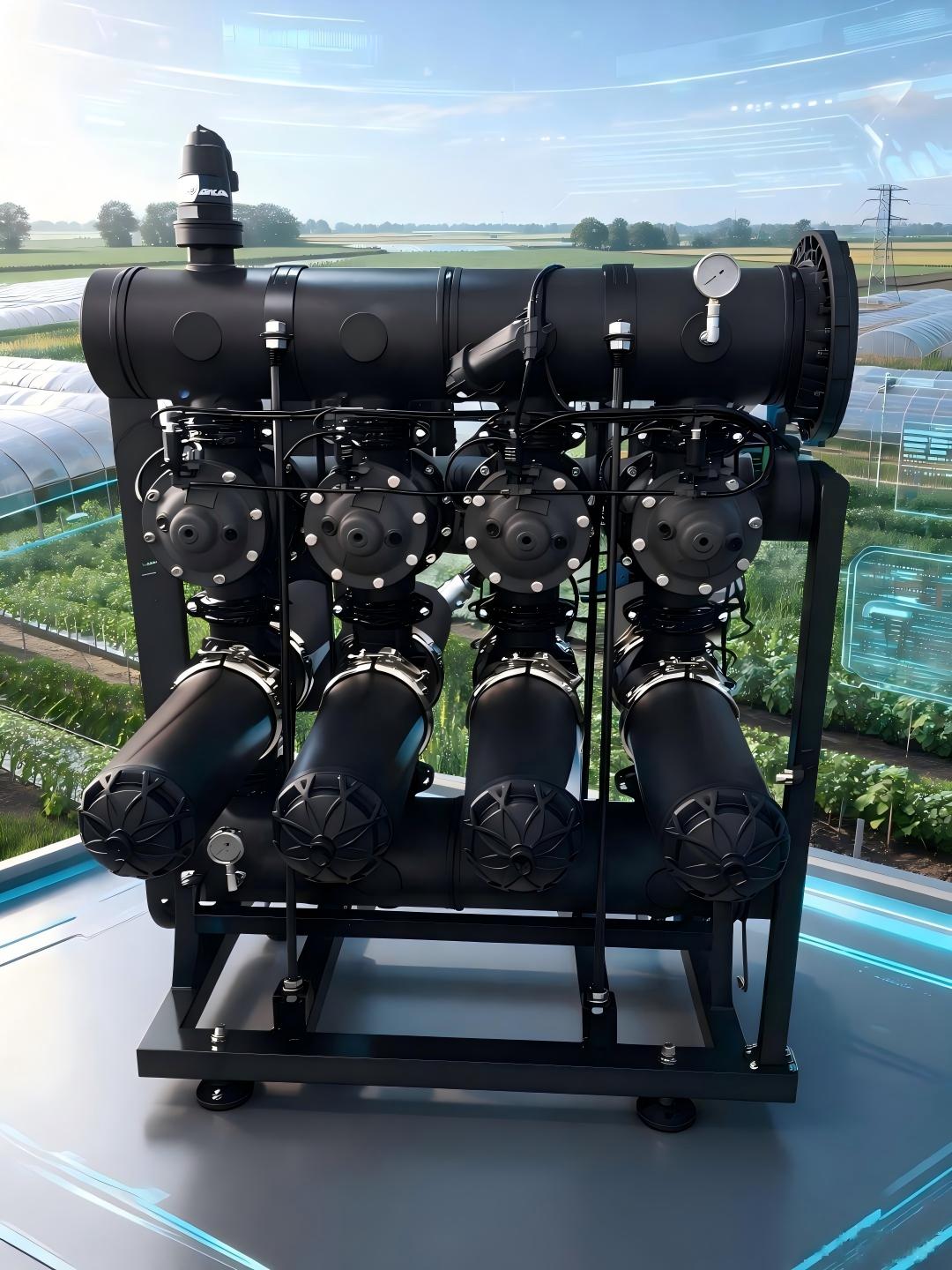
This article provides an in-depth analysis of the three-dimensional deep filtration principle, centrifugal water inlet design, and backwashing mechanism of disc filters, and offers selection recommendations for different irrigation scenarios.
Disc filters are among the most commonly used filtration equipment in modern agricultural irrigation systems. Their unique three-dimensional deep filtration structure enables excellent performance when treating various water sources. This article will provide an in-depth analysis of the working principle of disc filters and offer a detailed selection guide.
## 1. Working Principle of Disc Filters
### 1.1 Three-Dimensional Deep Filtration
The core of a disc filter is a set of plastic discs with grooves. When the discs are compressed, the grooves on adjacent discs interlock to form three-dimensional filtration channels. As water flows through these channels, impurities are trapped on the surface and deep within the discs, achieving high-efficiency filtration.
Compared with traditional screen filters, disc filters have a larger filtration area, stronger dirt-holding capacity, and higher filtration precision. The LZHS series disc filters adopt a grooved design, which enables more thorough and precise three-dimensional deep stereoscopic filtration.
### 1.2 Centrifugal Water Inlet Design
The LZHS disc filter is equipped with a built-in spiral structural component. After water enters the filter, it rotates at high speed, generating a centrifugal effect. Large and heavy impurities in the water are thrown against the filter wall under centrifugal force, moving away from the disc filter element and concentrating at the top of the filter.
This design greatly improves filtration efficiency, reduces backwashing frequency, and extends the service life of the filter element. At the same time, the centrifugal water inlet also reduces head loss and lowers system energy consumption.
### 1.3 Backwashing Mechanism
When sufficient impurities accumulate on the disc filter element, the system pressure difference increases, and backwashing is required. The LZHS disc filter supports both manual and automatic backwashing methods:
- **Manual backwashing**: The operator manually loosens the disc compression device, and uses water pressure or an external water source to flush impurities on the disc surface
- **Automatic backwashing**: The system automatically triggers backwashing via a pressure difference sensor or timer, and completes backwashing using clean water filtered by other filtration units or an external water source
During backwashing, the discs are loosened, and water flows through the discs in the reverse direction, flushing trapped impurities out of the filter. The entire process does not require disassembly of the filter element, making operation simple and convenient.
## 2. Selection Guide for Disc Filters
### 2.1 Selection Based on Flow Rate
When selecting a disc filter, the first consideration is the design flow rate of the system. The LZHS series disc filters are available in multiple specifications:
- 2-inch manual disc filter unit: maximum flow rate 34 m³/h
- 3-inch manual disc filter unit: maximum flow rate 56 m³/h
- 3-inch automatic backwashing unit: single unit flow rate 20-40 m³/h
- 4-inch automatic backwashing unit: single unit flow rate 30-60 m³/h
For high-flow systems, multiple units can be connected in parallel to achieve large-flow treatment through unit combination.
### 2.2 Selection Based on Filtration Precision
The selection of filtration precision depends on source water quality and irrigation method:
- 80 mesh (green discs): suitable for scenarios with good water quality, such as reservoir water and pond water
- 120 mesh (red discs): suitable for average water quality, and is a common choice for drip irrigation systems
- 150 mesh (orange discs): suitable for scenarios with poor water quality or high filtration requirements, such as micro-sprinkler and drip arrow systems
For drip irrigation systems, a filtration precision of no less than 120 mesh is recommended; for micro-sprinkler systems, no less than 150 mesh is recommended.
### 2.3 Selection Based on Control Method
- **Manual disc filters**: suitable for small-scale systems and scenarios with limited budgets, requiring regular manual backwashing
- **Automatic backwashing disc filters**: suitable for medium and large-scale systems and unattended scenarios, supporting automatic backwashing via pressure difference and timing
The LZHS H-type fully automatic backwashing disc filtration system adopts a professional backwashing controller, supporting three control methods: pressure difference induction, timed start, and on-demand start, making it an ideal choice for large-scale agricultural irrigation.
## 3. Installation and Maintenance Recommendations
### 3.1 Installation Precautions
1. The filter should be installed between the water source and the irrigation system, and a pressure gauge is recommended to be installed in front of the filter
2. Automatic backwashing filters require connection to a power supply and a sewage discharge pipeline
3. The inlet and outlet directions of the filter must not be reversed; installation should follow the direction of the arrow on the valve body
4. It is recommended to install valves before and after the filter to facilitate isolation during maintenance
### 3.2 Daily Maintenance
1. Regularly check the pressure difference before and after the filter; backwashing should be performed when the pressure difference exceeds 0.5 Bar
2. Regularly check whether the discs are damaged or deformed, and replace them promptly if any issues are found
3. Drain the accumulated water inside the filter during winter shutdown to prevent frost cracking
4. When not in use for an extended period, remove the discs for cleaning and drying to avoid bacterial growth
## 4. Conclusion
With their high-efficiency three-dimensional deep filtration, excellent centrifugal water inlet design, and convenient backwashing mechanism, disc filters have become the preferred filtration equipment for modern agricultural irrigation systems. The LZHS series disc filters from Henan Haojun Agricultural Technology Co., Ltd., backed by 14 years of export experience and strict quality control, are exported to Indonesia and multiple countries in Southeast Asia, making them a reliable choice for your irrigation system.
When selecting a filter, comprehensive consideration should be given to system flow rate, source water quality, and irrigation method to choose the appropriate specification, precision, and control method. Correct installation and maintenance can ensure long-term stable operation of the filter and protect your irrigation system investment.