Vineyard Irrigation Management for Wine Grapes
In modern agricultural production, Vineyard Irrigation Management for Wine Grapes has become a key factor in improving crop yields and conserving water resources. With global climate change and increa
In modern agricultural production, Vineyard Irrigation Management for Wine Grapes has become a key factor in improving crop yields and conserving water resources. With global climate change and increasingly severe water scarcity, scientific irrigation management is crucial for sustainable agricultural development. This article will explore the technologies, application methods, and best practices related to Vineyard Irrigation Management for Wine Grapes, helping farmers and agricultural professionals better understand and apply these techniques.
## Technical Principles and Working Mechanism
The core principle of Vineyard Irrigation Management for Wine Grapes lies in precise water regulation to meet crop water requirements at different growth stages. Traditional irrigation methods often suffer from severe water waste, poor irrigation uniformity, and soil compaction. Modern vineyard irrigation technology achieves efficient water use through scientific system design and precise control equipment.
From a working mechanism perspective, a complete irrigation system typically includes four main components: water source works, headworks, distribution pipeline network, and field emitters. The water source can be surface water, groundwater, or treated reclaimed water. Headworks include pumps, filters, fertilization devices, pressure regulation, and control equipment.
## Application Advantages and Benefit Analysis
Adopting Vineyard Irrigation Management for Wine Grapes technology can bring significant benefits to agricultural production in multiple aspects. First is water-saving efficiency: compared to traditional flood irrigation, precision irrigation technology typically saves 30% to 60% of water resources. This is particularly important in water-scarce regions, effectively alleviating conflicts between agricultural water use and other water sectors.
Second is yield-increasing benefits: scientific irrigation management ensures that crops receive adequate water and nutrient supply during critical growth periods, avoiding yield losses caused by water stress. Practice shows that crop yields with modern irrigation technology can typically increase by 15% to 40%, while product quality is also significantly improved.
Third is cost reduction and efficiency improvement: precision irrigation reduces the use of fertilizers and pesticides, lowering production costs. Meanwhile, automated control systems reduce labor input and improve production efficiency. Overall, the investment in modern irrigation systems can typically be recovered within 2 to 5 years, with considerable long-term economic benefits.
## Implementation Key Points and Technical Specifications
Successful implementation of Vineyard Irrigation Management for Wine Grapes requires attention to the following key aspects. First is system design, which must be personalized based on local climate conditions, soil characteristics, crop types, and planting patterns. Design content includes determination of irrigation schedules, system flow calculation, pipeline hydraulic calculation, emitter selection and layout, etc. It is recommended that professional agricultural engineering technicians conduct site surveys and system design to ensure scientific validity and applicability.
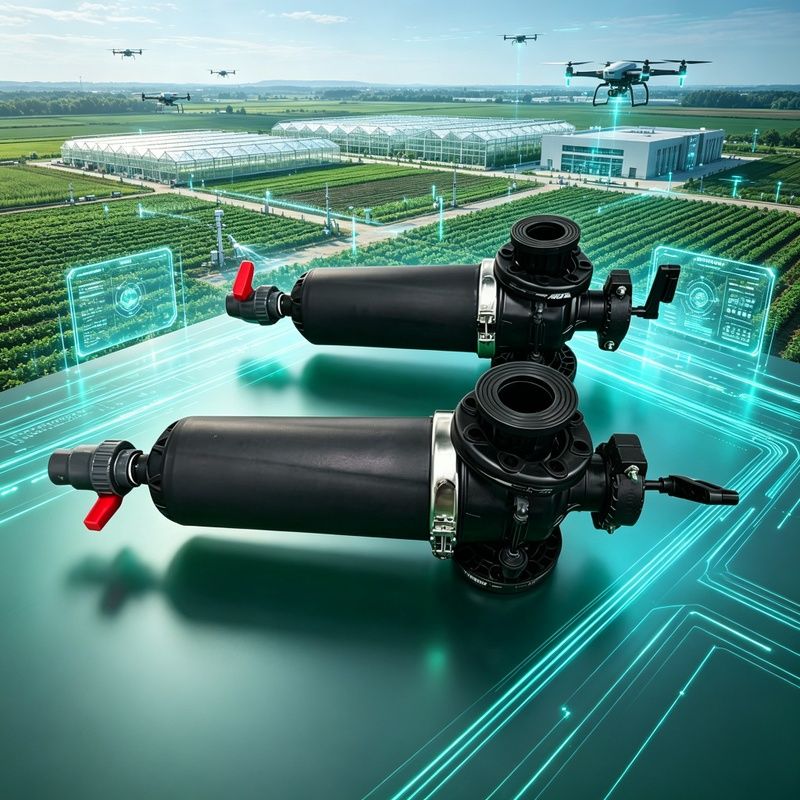
Second is equipment selection: reliable quality and stable performance irrigation equipment should be chosen. Key equipment includes pumps, filters, control valves, pressure regulators, flow sensors, and controllers. Filtration equipment is particularly crucial for protecting emitters from clogging. Depending on source water quality, disc filters, mesh filters, sand media filters, or centrifugal filters can be selected, or a multi-stage filtration combination can be adopted.
Third is installation and construction: construction must be carried out strictly according to design drawings and technical specifications. Pipeline laying depth, connection methods, slope control, air vent and drain valve settings must all meet specification requirements. After installation, system flushing and pressure testing should be performed to ensure the system is leak-free and operating normally.
Fourth is operation management: establish scientific irrigation schedules and operating procedures. Based on crop water requirements at different growth stages and soil moisture monitoring data, reas