Application Technology of Centrifugal Filters in Sand Removal from Well Water and River Water
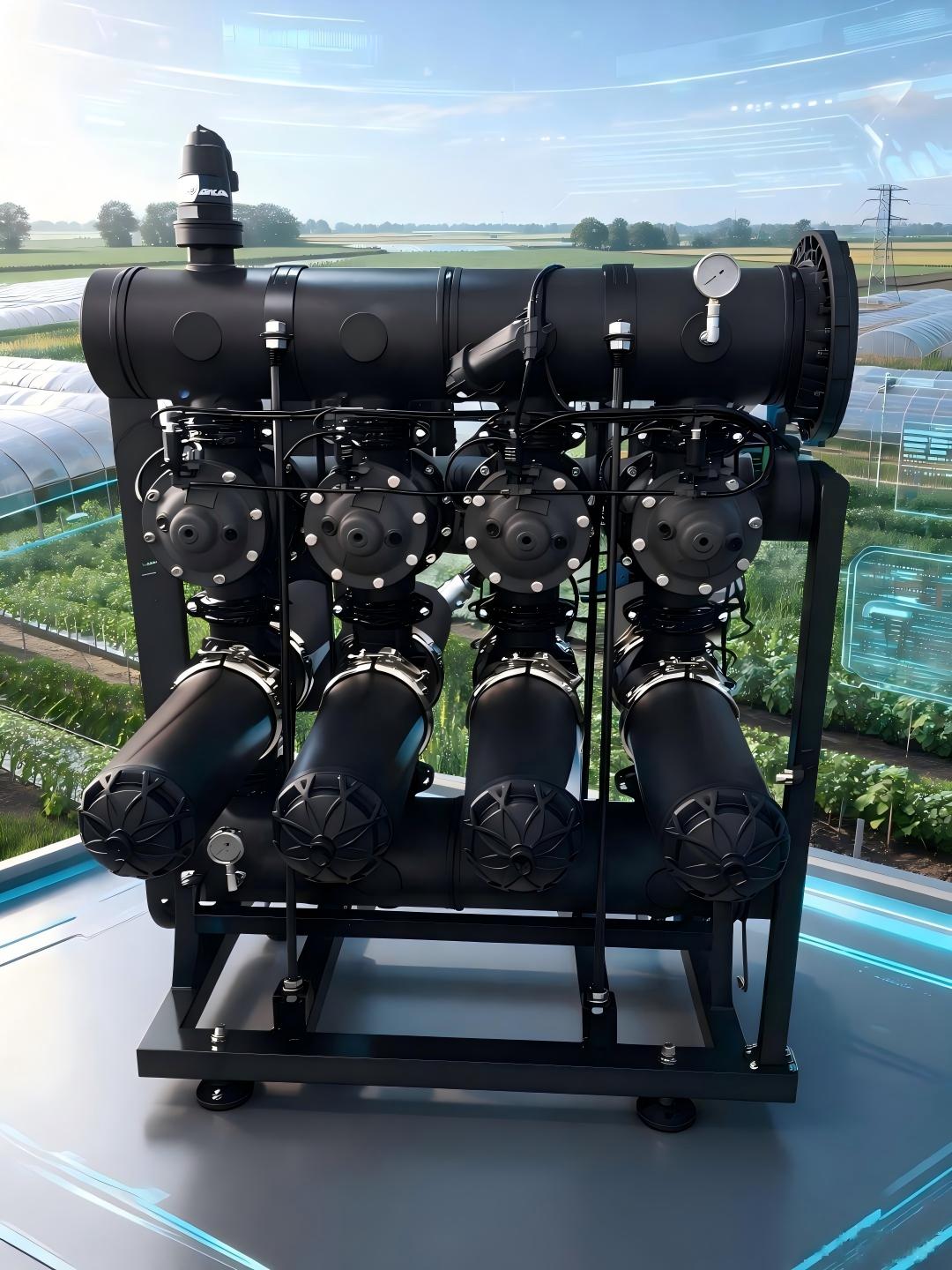
This article details the working principle, technical parameters, selection methods, and key points for installation and maintenance of centrifugal filters, with a focus on analyzing their application advantages in treating high-sediment water sources such as well water and river water.
In agricultural irrigation, well water and river water are the most commonly used water sources. However, these water sources often contain large amounts of sediment and impurities. Without effective filtration, they will seriously clog drippers and sprinklers, affecting the normal operation of the irrigation system. As an efficient primary sand removal equipment, centrifugal filters have unique advantages in treating high-sediment water sources.
## 1. Working Principle of Centrifugal Filters
The working principle of centrifugal filters (also known as hydrocyclone sand removers) is based on centrifugal separation technology. When water flow enters the filter cylinder from the tangential direction at a certain pressure and speed, it rotates at high speed along the cylinder wall, generating strong centrifugal force.
Solid particles in water (such as sediment, rust, etc.) have a higher density than water, so they are thrown towards the cylinder wall under the action of centrifugal force, move downward in a spiral along the cylinder wall, and finally settle into the sand collection chamber at the bottom of the filter. The purified water flows upward through the outlet pipe in the center of the filter and enters the subsequent filtration system.
The LZHS series plastic centrifugal filters are made of high-quality engineering plastics, with advantages such as light weight, corrosion resistance, and convenient installation, making them ideal primary sand removal equipment for agricultural irrigation systems.
## 2. Technical Features of Centrifugal Filters
### 2.1 Efficient Sand Removal
Centrifugal filters can effectively separate solid particles heavier than water in water, with a removal efficiency of over 90% for sediment with a particle size greater than 0.1mm. In the treatment of high-sediment water sources such as well water and river water, centrifugal filters, as primary filtration equipment, can greatly reduce the burden on subsequent disc filters or screen filters, extending their service life and backwashing cycle.
### 2.2 Consumable-free Design
Unlike disc filters and screen filters, centrifugal filters have no wearing parts such as filter elements, do not require replacement of filter materials, and have low operating costs. The equipment itself is made of high-quality engineering plastics, which is corrosion-resistant, anti-aging, and has a long service life.
### 2.3 Automatic Sewage Discharge
The bottom of the centrifugal filter is equipped with a sand collection chamber and a sewage valve. The collected sediment can be discharged by opening the sewage valve regularly. The LZHS series centrifugal filters support both manual and automatic sewage discharge modes. The automatic sewage discharge type can automatically trigger sewage discharge through a timer or differential pressure sensor, realizing unattended operation.
### 2.4 Low Head Loss
Centrifugal filters adopt an optimized flow channel design, with low water flow resistance and low head loss. Under rated flow, the head loss generally does not exceed 0.3 Bar, which has little impact on system pressure.
## 3. Technical Parameters of LZHS Centrifugal Filters
The main technical parameters of the LZHS series plastic centrifugal filters produced by Henan Haojun Agricultural Technology Co., Ltd. are as follows:
| Model | Specification | Maximum Flow | Working Pressure | Connection Method |
|-------|---------------|--------------|------------------|-------------------|
| LZHS3lx | 3 inches | 50 m³/h | 10 Bar | Flange/Clamp |
| LZHS4lx | 4 inches | 100 m³/h | 10 Bar | Flange/Clamp |
- Maximum working temperature: 60℃
- Material: High-quality engineering plastic (PP + glass fiber reinforced)
- Sand removal efficiency: ≥90% (particle size ≥0.1mm)
- Head loss: ≤0.3 Bar (under rated flow)
## 4. Selection Methods for Centrifugal Filters
### 4.1 Selection According to Flow
When selecting a centrifugal filter, the appropriate specification should be chosen according to the design flow of the system. The rated flow of the filter should be greater than or equal to the maximum flow of the system to ensure the centrifugal effect. If the flow is too small, the rotation speed of the water flow will be insufficient, resulting in poor centrifugal effect and reduced sand removal efficiency.
LZHS3lx (3 inches) is suitable for systems with a flow not exceeding 50 m³/h, and LZHS4lx (4 inches) is suitable for systems with a flow not exceeding 100 m³/h. For systems with larger flow, multiple units can be connected in parallel.
### 4.2 Selection According to Sediment Content
If the sediment content of the water source is high (such as river water in rainy seasons, newly dug well water), it is recommended to select a filter one size larger to increase the capacity of the sand collection chamber and reduce the frequency of sewage discharge. At the same time, it is recommended to install a disc filter or screen filter after the centrifugal filter for secondary fine filtration.
### 4.3 Selection According to Installation Space
Centrifugal filters require a certain installation height to ensure that the water flow can fully rotate and settle. Generally speaking, the installation height of the filter should not be less than 1.5 meters. If the installation space is limited, a horizontal centrifugal filter can be selected, but the sand removal efficiency will be slightly reduced.
## 5. Key Points for Installation and Maintenance
### 5.1 Installation Precautions
1. The centrifugal filter should be installed vertically, with the water inlet entering in the tangential direction and the water outlet facing upward
2. Sufficient space should be reserved at the bottom of the filter to facilitate sewage discharge and cleaning of the sand collection chamber
3. It is recommended to install pressure gauges before and after the filter to monitor the operating status
4. Valves should be installed at the inlet and outlet of the filter to facilitate isolation during maintenance
5. The sewage pipe should be led to a drainage ditch or collection tank to avoid sewage overflow
### 5.2 Operation and Maintenance
1. Regularly check the pressure difference before and after the filter; the pressure difference should be less than 0.3 Bar during normal operation
2. Discharge sewage regularly according to the sediment content of the water source. It is generally recommended to discharge sewage 1-2 times a day, for 10-30 seconds each time
3. Regularly open the sand collection chamber for inspection and clean up the deposited sediment
4. When shutting down in winter, drain the accumulated water in the filter to prevent frost cracking
5. When not in use for a long time, clean the inside of the filter thoroughly and store it after drying
## 6. Application in Multi-stage Filtration Systems
In actual agricultural irrigation systems, centrifugal filters are usually used as primary filtration equipment, combined with disc filters or screen filters to build a multi-stage filtration system:
**Primary filtration (centrifugal filter)**: Remove large-particle sediment and heavy impurities in water, reducing the burden on subsequent filtration equipment
**Secondary filtration (disc filter/screen filter)**: Further filter fine impurities in water to protect drippers and sprinklers from clogging
This multi-stage filtration combination can effectively treat various water qualities and ensure the long-term stable operation of the irrigation system. Henan Haojun Agricultural Technology Co., Ltd. can provide complete multi-stage filtration system solutions according to customers' water source quality and irrigation methods.
## 7. Summary
With their efficient sand removal capacity, consumable-free design, automatic sewage discharge function, and low head loss, centrifugal filters have become ideal primary filtration equipment for treating high-sediment water sources such as well water and river water. The LZHS series plastic centrifugal filters are made of high-quality engineering plastics, with light weight, corrosion resistance, and convenient installation, making them a reliable choice for agricultural irrigation systems.
When selecting, comprehensive consideration should be given to system flow, water source sediment content, and installation space. Correct installation and regular maintenance can ensure the long-term and efficient operation of centrifugal filters and protect your irrigation system investment. Henan Haojun Agricultural Technology Co., Ltd. has 14 years of experience in exporting irrigation equipment, with products sold far to Indonesia and multiple countries in Southeast Asia, and can provide you with professional filtration system solutions.