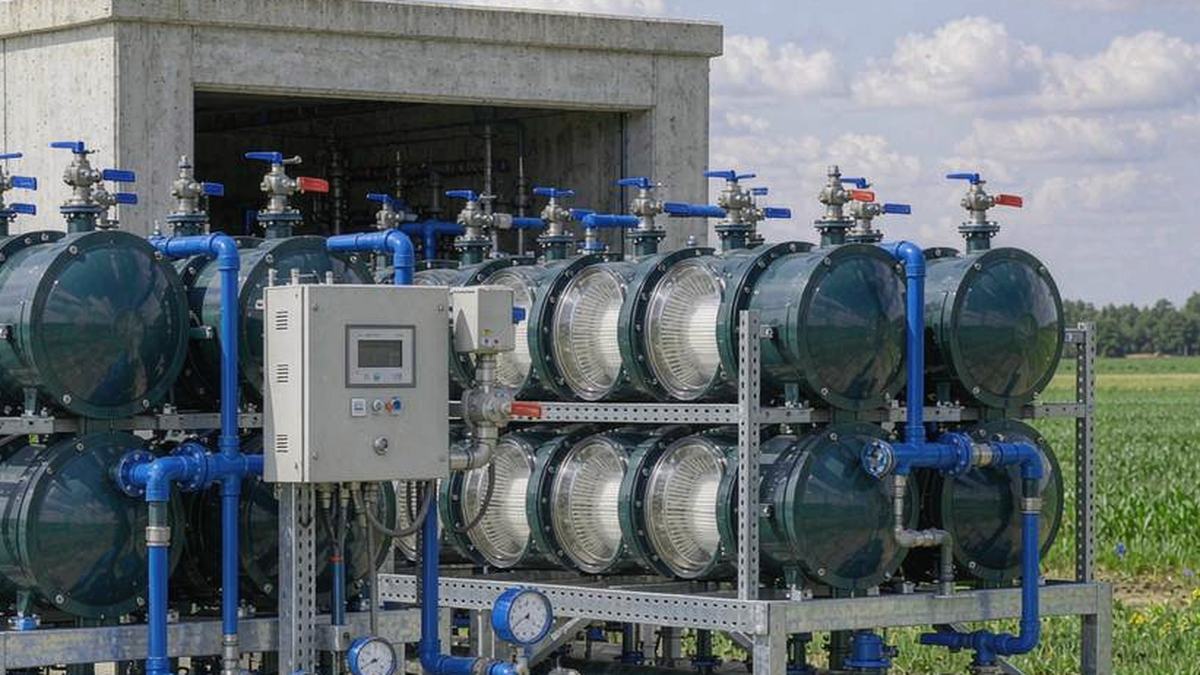
Key Takeaways
- Prioritize filter sizing matched to local water source quality (well, river, or pond) to prevent excessive pressure loss and emitter clogging for end users
- Verify backwashing mechanism compatibility to reduce long-term maintenance costs for your B2B agricultural and commercial customers
- Source units with standardized component interoperability to streamline after-sales support across different regional markets
- Partner with a seasoned export-focused manufacturer to get customizable specs that align with local irrigation industry norms
Understand Core Performance Specs for Sand Media Irrigation Filters
Before evaluating any product line, it is critical to align your inventory offerings with the technical specs that matter most to end users. The first key distinction to clarify is mesh vs micron ratings for downstream complementary filters: a 20-mesh screen equals roughly 740 microns, while standard sand media filters for irrigation deliver nominal filtration ratings between 10 and 200 microns, designed to capture particles too fine for hydrocyclone separators to remove. Properly sized units maintain a clean pressure loss of 5 to 15 psi during normal operation, with a maximum acceptable 25 psi pressure drop before backwash is required. To ensure consistent, reliable backwash performance across all your sold units, we recommend equipping standard models with LZHS Two-Position Three-Way Valve (3") to cut manual operation labor for end users and eliminate the risk of operator error during flushing cycles.
Match Filter Design to Common Local Water Sources
The single largest factor that determines customer satisfaction with sand media filters is matching the unit’s tank size, media grade, and flow rate rating to the dominant water source in your sales region. For markets that rely heavily on well water for irrigation, sand media filters are ideal for capturing fine residual sand, mineral scale, and sediment that would otherwise abrade sprinkler parts and clog small drip emitters. For regions that draw irrigation water from rivers or open ponds, these filters effectively trap suspended algae, organic debris, and silt that cannot be removed by standard screen or disc filters alone. Dual-tank systems are recommended for high-flow commercial projects, as they allow one tank to operate in service mode while the other undergoes backwashing to avoid disrupting continuous water supply.
Evaluate Backwashing System Efficiency
Poor backwash design is the number one cause of premature sand media filter failure, so wholesalers and importers should audit this feature carefully before committing to bulk orders. Proper backwashing requires an upward flow rate 3 to 5 times the normal service flow to fully fluidize the silica or garnet filter bed, lifting trapped particles so they can be flushed out of the waste line. Low-quality units often use under-perforated drain systems that fail to distribute backwash flow evenly, leading to media caking, channeling, and even accidental loss of filter media into downstream irrigation lines. Top-tier designs from LZHS use precision-molded under-drain headers that eliminate these issues entirely, extending the usable lifespan of filter media by 2 to 3 times compared to lower-cost alternatives.
Optimize Inventory for Wholesale and Import Profit Margins
As a wholesaler or importer, your goal is to minimize redundant SKUs while maximizing the number of customer use cases a single base model can support. Modular sand media filter designs are the best way to achieve this, as they let you swap out small, low-cost components to adjust a base unit’s functionality for different project requirements. For example, adding LZHS 1/8"x8 Tee pressure gauge ports as a standard factory accessory lets end users easily install inlet and outlet pressure monitors without custom on-site fabrication, reducing installation time and eliminating the need for you to stock separate custom port SKUs. This modular approach lets you serve smallholder farm, large commercial farm, and greenhouse irrigation customers with a small, manageable inventory of core filter units.
Vet Manufacturer Credibility and Customization Options
Working with an experienced, export-focused irrigation filter manufacturer eliminates many of the common pain points that come with importing industrial water treatment equipment. LZHS brings 14 years of manufacturing and export experience serving 60+ countries, with full familiarity of regional irrigation standards, voltage requirements for automatic backwash controllers, and port size norms that vary across different global markets. We also offer full pre-shipment performance testing for every unit to ensure zero defects before products leave the factory, drastically reducing your post-import return and complaint rates. You can browse our full range of complementary irrigation filtration products to bundle with your sand media filter orders at our dedicated product hub, including disc filters, screen filters, hydrocyclone sand separators, Y-strainers, and T-type filters to build a full one-stop irrigation filtration product line for your customers.
FAQ
What micron rating should I prioritize for sand media filters sold for drip irrigation applications?
For drip irrigation end users, select sand media filters with a nominal 100 micron filtration rating to capture most large suspended solids, then recommend pairing the unit with a 120-mesh (125 micron) disc or screen filter as final stage protection to prevent fine particles from clogging small precision emitter nozzles.
How often do sand media filters require backwashing in typical agricultural use?
Most units trigger automatic backwash when pressure loss across the filter reaches 20 to 25 psi, which usually occurs every 8 to 24 hours of continuous operation. The exact frequency depends on the level of suspended solids in the end user’s source water, with pond and river water requiring more frequent backwashing than deep well water.
Can I bundle sand media filters with other irrigation filter types for bulk customer orders?
Yes, most large commercial irrigation projects require a multi-stage filtration setup, and wholesalers who offer pre-bundled kits see higher average order values. A typical well water kit combines a hydrocyclone sand separator as a first stage, sand media filter as second stage, and disc filter as final stage to deliver full protection for irrigation systems.