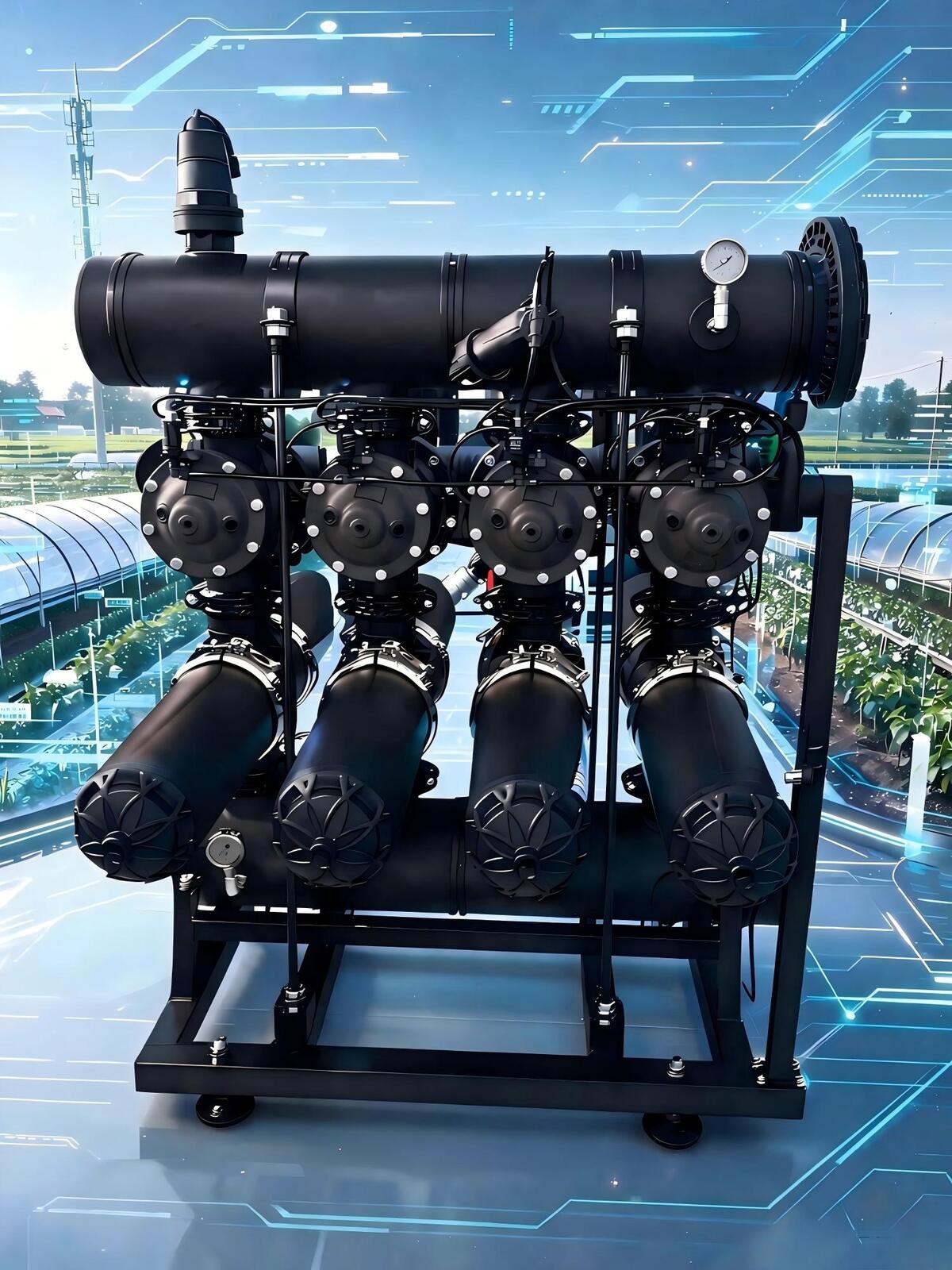
For pressurized agricultural irrigation systems—from drip and micro-sprinkler permanent crop orchards to center pivot-fed row crop operations—disc filter stacks are the first line of defense against emitter clogging, abrasive damage to pumps and valves, and costly yield loss from uneven water application. As global water scarcity drives increased adoption of high-efficiency irrigation (HEI) systems, the International Water Management Institute reports that disc filter use has grown 78% since 2015, as the technology offers higher filtration capacity, longer service life, and lower backwash water use than screen or media filters for most water sources. Yet 2023 data from the U.S. Department of Agriculture (USDA) Irrigation Efficiency Survey shows that 62% of HEI system failures are traced directly to inadequate disc filter stack maintenance, leading to an average 18% yield reduction in high-value crops including almonds, berries, and processing tomatoes when clogging reduces water uniformity by 20% or more. Properly maintained disc filter stacks reduce overall irrigation energy use by 12–17% by minimizing unnecessary pressure loss, cut backwash water waste by 30%, and extend the service life of downstream irrigation components by 40%, per 2022 Irrigation Association (IA) benchmarks. This comprehensive guide outlines evidence-based maintenance procedures, data-backed schedules, common cost-driving mistakes, and real-world return on investment (ROI) for agricultural disc filter stack care, tailored to farm operations of all sizes and water source types.
Why Disc Filter Stack Maintenance Is Non-Negotiable for Agricultural Irrigation
The Hard Cost of Neglected Disc Stacks: Industry-Wide Data
Disc filter stacks are composed of tightly compressed, grooved polypropylene discs mounted on a central spine, designed to capture sediment, organic matter, algae, and mineral precipitates as water flows through the 3D matrix of offset grooves. When stacks are misaligned, worn, or caked with debris, unfiltered water can bypass the filtration matrix entirely, leading to cascading system damage. A 2024 University of California, Davis, study of 120 Central Valley almond orchards found that operations with unmaintained disc stacks experienced 3x higher rates of emitter clogging, 22% higher pesticide application costs due to root rot caused by sediment-borne pathogen carryover, and an average $1,240 per acre in lost revenue during drought years when irrigation uniformity is critical to yield. For operations using recycled tailwater or treated effluent—an increasingly common water source as groundwater regulations tighten—unmaintained disc stacks increase bacterial slime and biofilm buildup in lateral lines by 4.7x, leading to complete system clogging in as little as three irrigation cycles during peak summer temperatures, per 2023 Center for Irrigation Technology (CIT) at Cal State Fresno field trials.
Even minor gaps between compressed discs can cause major losses: field testing from Netafim released in 2023 found that a 1mm gap from misaligned or warped discs allows 40% of unfiltered water to bypass the filter matrix, regardless of the disc’s rated micron size. For context, a 120-micron disc filter is designed to capture all particles larger than 120 microns (about the diameter of a human hair), but a 1mm gap allows sand grains, silt, and algae clumps up to 1000 microns to pass directly to downstream emitters.
Core Disc Stack Functions Dependent on Routine Upkeep
Effective maintenance preserves four critical performance functions that disc filters are designed to deliver, all of which degrade rapidly without regular care:
- Consistent micron-rated filtration: Tight, evenly compressed discs ensure uniform particle capture across the entire stack surface, rather than allowing uneven flow that creates concentrated wear spots.
- Low, stable pressure differential: Clean, aligned discs maintain a 2–5 PSI pressure drop between inlet and outlet at design flow, reducing pump energy demand and preventing pipe fatigue from pressure spikes.
- Efficient backwash performance: Clear, unobstructed disc grooves allow reverse flow to flush trapped debris in 30–90 seconds, minimizing wastewater generation during cleaning cycles.
- Long component service life: Properly cared for discs protect fertilizer injectors, pressure regulators, valves, and emitters from abrasive sediment damage, extending the service life of these high-cost components by an average of 40%, per IA data.
Pre-Maintenance Prep: Safety, Tools, and Baseline Benchmarking
Safety Protocols to Prevent Injury During Service
Pressurized irrigation systems pose significant safety risks during filter maintenance: 2022 OSHA data shows that 17% of farm irrigation-related injuries occur during filter service when personnel fail to fully de-pressurize housings before opening clamps or bolts, leading to high-velocity water spray or flying housing components that cause lacerations, eye injuries, or blunt force trauma. All maintenance must start with formal lockout/tagout (LOTO) procedures and required personal protective equipment (PPE):
- Required PPE: Impact-resistant safety glasses, chemical-resistant nitrile gloves (for exposure to fertilizers, algaecides, or cleaning solutions), steel-toe boots, and hearing protection for systems operating at >60 PSI during backwash.
- LOTO step 1: Close both inlet and outlet isolation valves on the filter station to isolate the housing from system pressure.
- LOTO step 2: Open the top-mounted pressure relief valve and wait until the housing pressure gauge reads 0 PSI, confirming no residual pressure remains.
- LOTO step 3: Apply a personal lock and dated tag to both isolation valve handles, indicating maintenance is in progress and valves must not be opened.
- LOTO step 4: Open the nearest downstream flush valve to confirm zero flow before loosening any housing fasteners.
Required Tool Kit for Disc Stack Service
Disc filter stack maintenance does not require specialty, brand-specific tools for most agricultural models, but using incorrect tools can cause permanent damage to discs and housings. Assemble the following kit for every service event:
- Calibrated torque wrench (15–35 ft-lb range) to tighten compression nuts and housing clamps to factory specifications, avoiding over-tightening damage.
- Soft-bristle nylon bristle brush (never metal bristle brushes, which scratch disc grooves) for removing trapped sediment.
- 5-gallon cleaning buckets, with separate solutions for organic buildup (1% household chlorine bleach solution) and mineral buildup (2% food-grade citric acid solution, pH 2.5–3).
- Digital manometer or pressure gauge set to measure differential pressure across the filter to within 0.5 PSI accuracy.
- Digital calipers to measure disc groove depth, to identify worn discs that require replacement.
- Food-grade silicone lubricant for housing o-rings (never petroleum-based lubricants, which degrade rubber and cause premature cracking).
- Spare part inventory: Maintain a minimum 10% stock of spare discs matched to the system’s micron rating, replacement o-rings, and compression springs for each filter station, per IA best practices, to avoid delays from missing parts during service.
Establish Baseline Performance Metrics Before Disassembly
Before taking any disc stack apart, record key performance metrics to identify issues that may not be visible during visual inspection. 2021 Toro Agricultural Irrigation field trials found that farms that recorded baseline metrics before every maintenance event reduced unplanned filter-related downtime by 47% compared to operations that performed reactive cleaning without benchmarking. Record the following data points for each station at spring startup and after every service:
- Clean pressure differential: A fully functional, clean disc stack will show a 2–5 PSI difference between inlet and outlet pressure when operating at design flow rate. A differential >7 PSI after cleaning indicates misalignment, wear, or trapped air.
- Design flow rate: Match measured flow to factory specs—for example, a standard 4-inch disc filter with 120-micron discs is rated for 130 GPM; flow rates 20% above design cause accelerated disc wear and high pressure loss.
- Backwash performance: A properly functioning stack will produce murky, debris-laden effluent for 30–90 seconds during backwash, then run clear. Cycles shorter than 20 seconds indicate water is bypassing around the stack, while cycles longer than 2 minutes indicate embedded debris that requires manual cleaning.
Disc Filter Stack Maintenance Schedules and Step-by-Step Procedures
Maintenance frequency is not one-size-fits-all: water source total suspended solids (TSS), organic load, and seasonal variability determine how often inspection and deep cleaning are required. The table below summarizes evidence-based maintenance schedules, time requirements, and risk levels across common agricultural water sources, based on 2023 CIT field trials across 87 farm sites in the western U.S.:
| Water Source Type | Routine No-Disassembly Inspection Interval | Full Stack Disassembly & Deep Cleaning Interval | Average Annual Maintenance Time Per 4-Inch Filter Station | Expected Disc Stack Service Life With Adherence to Schedule | Risk of >20% Emitter Clogging When Maintenance Is Delayed |
|---|---|---|---|---|---|
| Groundwater (well) with <50 ppm TSS, low organic load | Every 4 weeks during irrigation season | Every 6 months | 2.1 hours | 8–10 years | 12% risk if delayed 2+ weeks |
| Surface water (river/canal) with 50–200 ppm TSS, seasonal sediment loads | Every 1 week during irrigation season | Every 2 months | 7.8 hours | 5–7 years | 48% risk if delayed 1+ week |
| Recycled tailwater/treated effluent with >200 ppm TSS, high organic/biofilm load | Every 2 days during irrigation season | Every 2 weeks | 22.3 hours | 3–5 years | 89% risk if delayed 3+ days |
| Blended source (well + surface) with seasonal spring/summer algae blooms | Every 3 days during bloom season; every 2 weeks during non-bloom periods | Every 1 month during bloom season; every 4 months during non-bloom periods | 12.6 hours | 4–6 years | 72% risk if delayed 2+ days during algae bloom season |
Routine No-Disassembly Check Procedure
Between full deep cleans, perform the following checks at the scheduled inspection interval to catch issues before they cause clogging:
- Record inlet and outlet pressure at the start of each irrigation cycle: A 5 PSI rise above the clean baseline indicates the stack is 60% clogged and requires an immediate manual backwash. CIT research shows that waiting until differential pressure reaches 10 PSI above baseline reduces backwash efficiency by 65%, as compacted sediment becomes embedded deep in disc grooves and cannot be removed with reverse flow alone.
- Trigger a manual backwash and observe waste effluent: Clear water in <10 seconds indicates disc misalignment and flow bypass, while murky water after 2 minutes of backwash indicates embedded debris requiring full disassembly.
- Inspect for external leaks around the housing clamp or lid: Slow drips often signal uneven stack compression causing internal pressure spikes, which can lead to sudden housing failure during high-flow periods.
Full Stack Disassembly and Deep Cleaning Step-by-Step
When it is time for a full deep clean, follow this standardized procedure to avoid damage, misalignment, and post-maintenance performance issues:
- After completing LOTO and de-pressurization, loosen housing bolts or clamps in a crisscross pattern to avoid warping the lid, then lift the lid straight up to avoid bending the central tension rod.
- Lift the entire disc stack straight up off the central spine, taking care not to drop individual discs into the housing, which can lodge in the outlet line and cause downstream clogging. A standard 4-inch 120-micron disc stack contains 120–150 individual discs, arranged to create offset groove channels for filtration.
- Loosen the top compression nut to release tension on the stack, then lay discs out on a clean, flat surface in the exact order they were removed. Never mix discs from different filter stations, as wear patterns vary and mixing creates micro-gaps between discs. A 200-acre processing tomato farm in the Central Valley of California reported 22% emitter clogging across a 40-acre block in 2022 after maintenance staff mixed discs from three adjacent filter stations during service; misaligned grooves created 0.2–0.8mm gaps that allowed fine silt to bypass for three irrigation cycles before the issue was diagnosed, costing $17,200 in yield loss and line flushing labor.
- Inspect each disc for damage using digital calipers and visual checks: Replace any disc with cracked edges, visible warping, or groove depth <0.5mm (original factory groove depth for 120-micron discs is 0.8mm; wear to 0.5mm reduces filtration efficacy by 35%).
- Clean discs using only the soft nylon brush and appropriate cleaning solution: Soak discs with heavy organic slime or algae in the 1% chlorine solution for 30 minutes before scrubbing; soak discs with calcium, iron, or manganese mineral deposits in the 2% citric acid solution for 45 minutes to dissolve precipitates before scrubbing. Never use a pressure washer to clean discs: 3000+ PSI spray wears groove edges by 0.1–0.2mm per cleaning, reducing disc service life by 40%.
- Inspect the central spine, compression spring, and plastic end caps: Replace bent spines (which cause uneven compression), springs with >10% tension loss, or cracked end caps that allow discs to shift.
- Reassemble the stack in the original order, ensuring each disc sits flat against the one below it. Tighten the top compression nut to factory spec (typically 20 ft-lbs for 4-inch filters), then perform a light test: Hold the assembled stack up to a bright light source. If any light shines through gaps between discs, realign the discs to eliminate bypass paths.
- Inspect the housing o-ring for cracks, flat spots, or brittleness, wipe it clean, apply a thin layer of food-grade silicone lubricant, and replace if damaged. 2023 Netafim field service data shows that 38% of post-maintenance filter leaks are caused by dried, cracked o-rings that were not inspected during service.
- Lower the reassembled stack back into the housing, replace the lid, and tighten clamps/bolts in a crisscross pattern to the specified torque.
- Slowly open the inlet valve to fill the housing, bleed all trapped air from the top relief valve, then fully open the outlet valve. Record the new clean pressure differential to update baseline metrics, then run two manual backwash cycles to confirm no leaks and proper flow.
Seasonal Maintenance Adjustments for High-Risk Periods
Adjust maintenance frequency and procedures to account for seasonal risk factors that accelerate clogging and wear:
- Spring algae bloom season for surface water systems: Increase inspection frequency to every 2 days, add a quarterly 30-minute algaecide soak for discs to prevent slime adhesion, and install a 200-micron pre-screen upstream to reduce large organic load on disc stacks.
- Post-harvest winter shutdown: Fully disassemble all disc stacks, clean and dry individual discs, coat metal spines and springs with food-grade rust inhibitor, and store discs in a cool, dry location out of direct UV light. UV exposure and cold, wet conditions cause polypropylene disc brittleness, leading to 25% faster wear when stacks are left assembled in housings during off-season months. A 500-acre pecan farm in southern Georgia reduced annual disc replacement costs by 31% between 2021 and 2023 after implementing off-season disc storage, eliminating cracking and microbial degradation that occurred when stacks were left assembled in cold, water-filled housings.
- Fertilizer injection season: After every 10 hours of liquid fertilizer injection, perform a 10-minute fresh water flush of filter housings to prevent fertilizer residue from crystallizing on disc grooves, which causes rapid pressure rise and reduces backwash efficiency.
Common Disc Stack Maintenance Mistakes That Drive Unnecessary Costs
Over-Tightening Components to “Improve” Filtration
Many farm operators assume that tighter compression of discs and clamps equals better filtration, but over-tightening causes more damage than under-tightening. CIT testing found that over-tightening a disc stack compression nut to 40 ft-lbs (double the recommended 20 ft-lbs for 4-inch filters) warps 15–20% of discs in the stack, creating an average 22% bypass rate of unfiltered water. Over-tightened housing clamps also cause o-ring extrusion, leading to leaks that require emergency shutdowns and replacement of damaged rubber seals.
Using Incorrect Cleaning Tools or Chemicals
Shortcuts during cleaning cause permanent disc damage and reduced performance:
- Metal bristle brushes scratch disc grooves, creating crevices that trap sediment and bacteria, reducing backwash efficiency by 40% and increasing biofilm growth.
- Petroleum-based lubricants (e.g., motor oil, WD-40) on o-rings cause rubber to swell and crack within 3 months of application, leading to costly leaks.
- Chlorine concentrations higher than 2% for cleaning degrade polypropylene disc material, making discs brittle and reducing service life by 50% after three high-concentration soaks.
- High-pressure power washers erode disc groove edges, increasing the effective micron rating of the filter over time and allowing larger particles to pass through.
Ignoring Early Warning Signs of Stack Wear
The IA reports that 71% of farms wait until emitters are visibly clogged before addressing disc filter issues, leading to 3x higher maintenance costs for line flushing and emitter replacement compared to addressing early warning signs. Key early indicators that require immediate stack inspection include: pressure differential that never returns to the 2–5 PSI baseline after cleaning, backwash cycles shorter than 20 seconds, visible sediment in downstream flush samples, and unusual housing vibration during operation that signals uneven flow distribution.
Mixing Micron Ratings or Disc Types in a Single Stack
When spare discs are in short supply, maintenance staff may substitute mismatched discs of a different micron rating or from a different manufacturer, but this creates gaps and inconsistent filtration. Rain Bird field testing found that even one mismatched disc in a stack increases the overall effective micron rating by 45%, allowing larger particles to bypass. A 120-acre blueberry farm in Oregon experienced widespread iron ochre clogging in 2023 after staff used ten 200-micron discs to replace cracked 120-micron discs in two filter stations; the larger gaps allowed iron bacteria particles to pass through, clogging 38% of emitters across 60 acres, requiring 120 hours of flushing labor and $9,400 in replacement emitters.
Troubleshooting Persistent Performance Issues After Maintenance
Even after a full service, disc stacks may underperform due to easily missed issues. Use the following troubleshooting framework to resolve common problems:
Issue 1: High Pressure Differential (>7 PSI) Immediately After Cleaning
- Cause: Misaligned discs creating compacted flow channels. Fix: Disassemble the stack, realign each disc to sit flat, and repeat the light test to confirm no gaps.
- Cause: Worn compression spring with insufficient tension to hold discs evenly. Fix: Replace the spring if tension is <80% of factory specification, as weak springs allow discs to shift and compact unevenly during flow.
- Cause: Trapped air in the filter housing creating false high pressure readings. Fix: Open the top relief valve to bleed all air, then recheck pressure.
- Cause: Flow rate 20%+ above the filter’s design rating. Fix: Adjust outlet valves to reduce flow to factory-specified levels, or add additional filter stations to handle higher flow volume.
Issue 2: Sediment Bypass (Visible Particles Downstream, Emitter Clogging) Post-Service
- Cause: Warped or cracked discs creating bypass gaps. Fix: Replace all damaged discs and confirm compression nut torque matches factory spec.
- Cause: Incorrect stack height leaving a gap at the top of the spine. Fix: Measure compressed stack height against factory specs (e.g., 14 inches for a 4-inch 120-micron stack); add replacement discs if height is <13.5 inches to eliminate gaps.
- Cause: Damaged or missing o-ring creating a leak path around the stack. Fix: Replace the o-ring and ensure the clamp is tightened evenly in a crisscross pattern.
- Cause: Torn base screen under the stack. Fix: Replace the fine mesh screen at the bottom of the spine that prevents particles from passing under the disc stack.
Issue 3: Backwash Cycles Longer Than 2 Minutes With Persistently Murky Effluent
- Cause: Embedded, compacted sediment not removed during surface cleaning. Fix: Soak discs for 60 minutes in the appropriate cleaning solution, scrubbing each groove thoroughly to remove trapped material.
- Cause: Backwash pressure <25 PSI, insufficient to create turbulence between discs. Fix: Adjust valves to increase backwash pressure, or install a small booster pump to deliver the required 30+ PSI for effective flushing.
- Cause: Persistent biofilm buildup creating a sticky layer on discs that traps sediment. Fix: Implement a quarterly biofilm removal soak with a 1% chlorine solution to eliminate slime layers that cannot be removed by backwash alone.
Quantifying the ROI of Proactive Disc Filter Stack Maintenance
Real-World Cost Savings From Farm Operations
Proactive maintenance delivers measurable, rapid ROI by reducing yield loss, input costs, and component replacement expenses. Consider two case studies from farms that implemented structured disc filter maintenance programs:
- A 200-acre almond orchard in Kern County, California, recorded 14 unplanned irrigation shutdowns due to disc filter clogging in 2022, totaling 21 hours of downtime during peak nut fill. The clogging reduced irrigation uniformity to 72%, leading to a 9% yield loss (16,800 pounds of almonds, valued at $33,600 at $2/pound). After implementing bi-weekly inspections and monthly deep cleans during irrigation season, the orchard recorded zero unplanned filter shutdowns in 2023, reducing clogging-related yield loss to <1%. The total annual cost of maintenance labor was $2,400, delivering a 13:1 ROI from avoided yield loss alone.
- A 500-acre pecan operation in southern Georgia spent $18,700 annually on disc replacements, emitter flushing, and clogging-related yield loss before adopting a scheduled maintenance program in 2021. After aligning cleaning frequency to their surface water source TSS levels and implementing off-season disc storage, annual costs dropped to $9,200, delivering a 51% cost reduction, or $19 per acre in annual savings.
Additional savings come from reduced water and energy use: IA data shows properly maintained disc stacks reduce backwash water use by 30% annually, translating to 1.2 acre-feet of saved water per 400-acre surface water farm, worth $1,440 at 2024 western U.S. water market rates of $1,200 per acre-foot. USDA Natural Resources Conservation Service data adds that a 10 PSI pressure loss across clogged filters increases pump energy use by 0.22 kWh per 1000 gallons pumped, which for a farm applying 20 million gallons of irrigation water per season, wastes 4,400 kWh annually, costing $528 at $0.12/kWh. These costs are entirely eliminated when maintenance keeps pressure differential at the 2–5 PSI baseline.
Extended Component Service Life
Reactive maintenance (only cleaning discs when clogging causes a system failure) reduces disc stack service life to an industry average of 2–3 years, with full stack replacement costs of $350–$600 per 4-inch filter station. When proactive maintenance is followed, disc stack service life increases to 6–8 years, reducing annual replacement costs by 65%. For a farm with 10 filter stations, that equates to $2,275–$3,900 in annual savings on replacement parts alone. Proper disc maintenance also extends downstream emitter life from an average of 8 years to 12–15 years, reducing long-term system replacement costs by 33%.
Long-Term Best Practice Checklist for Disc Stack Performance
To lock in consistent performance and maximum ROI, implement the following standardized practices across all filter stations:
- Record baseline pressure differential, flow rate, and backwash duration for every filter station at spring startup each year, and update metrics after every service event.
- Maintain a 10% spare parts inventory of discs, o-rings, and compression springs for each filter model on site to avoid delays during maintenance.
- Never mix discs from different filter stations, or mix discs of different micron ratings or manufacturers within a single stack.
- Calibrate torque wrenches annually to ensure compression nuts and clamps are tightened to exact factory specifications.
- Collect downstream water samples monthly, pouring water through a white paper filter to check for invisible sediment bypass that may indicate gaps in the disc stack.
- Perform the light test on every reassembled disc stack to confirm no light passes through gaps between discs before placing the stack back in the housing.
- Flush all mainlines and laterals for 5–10 minutes immediately after any filter maintenance event to flush out any sediment that may have passed during service.
- Conduct annual hands-on training for all irrigation staff on LOTO safety, disc cleaning procedures, and performance benchmarking. IA data shows farms with annual filter maintenance training experience 39% fewer filter-related failures than operations with no formal training.